TRAVEL ALERT:  The FAA has issued a nationwide ground stop, impacting departures out of SBA. Travelers should check directly with their airline for latest flight information.

21437

Share your ideas for the future of Santa Barbara's parks, open spaces, recreation facilities, and programs by taking the Parks and Recreation Master Plan Survey and enter a drawing to win a $500 prepaid Visa gift card!

21438

Email service to the City of Santa Barbara has been restored.

City staff can once again send and receive email messages. Microsoft continues to monitor the service and process a backlog of messages that accumulated during the outage.

If you sent an email to a City department or employee during the outage and do not receive a response in a timely manner, please resend your message or contact the department directly. Department contact information can be found on our Contact Us page.

21426
Title

Recycled Water

Body
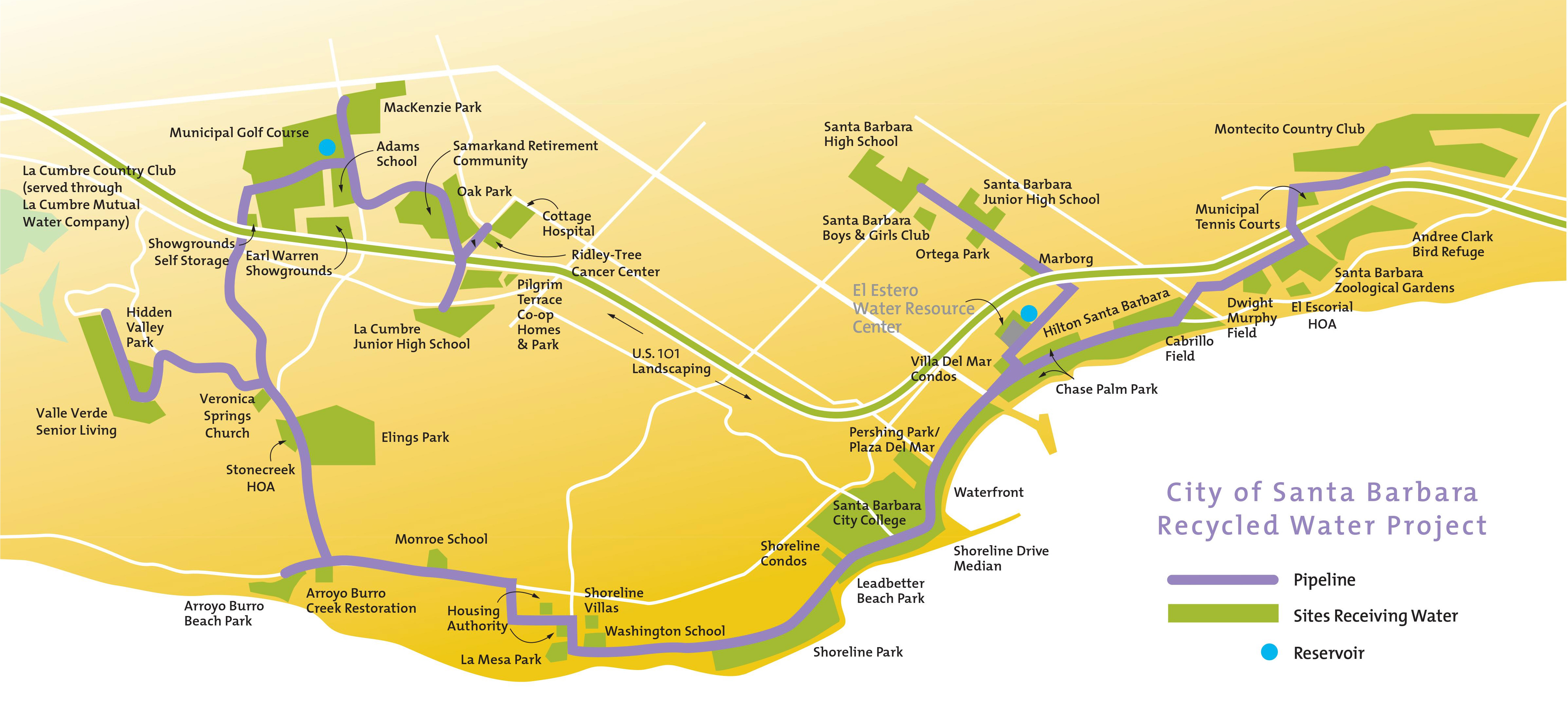
Map of Santa Barbara Recycled Water Project


(click to enlarge)

What is Recycled Water?

Treated wastewater (secondary effluent) is sent through filters to produce recycled water. The filtration or tertiary treatment process removes very fine particulate matter from the water using a type of membrane filtration in which hydrostatic pressure forces liquid against a semipermeable membrane. The filtered water is disinfected with sodium hypochlorite (bleach) prior to distribution. Recycled water is used mainly for irrigation of landscaping at parks, schools, the zoo, golf courses, homeowners associations, and retirement homes. Additionally, recycled water is also used at some sites for toilet flushing, dust control, and sidewalk cleaning. The recycled water distribution system uses completely separate pipelines from the City's drinking water system and is denoted by purple pipes, purple color-coded irrigation systems, and signage.

Sections

After several dry years in the late 1970’s, and continued population growth in the City, analysis of the City’s water supply showed that additional water sources were needed. Recycled water was identified as a potential substitute for potable water for irrigation and other uses. The City’s Recycled Water Project was developed in two phases. Phase I was completed in July 1989, and Phase II was completed in May 1991. The total cost of the project was $15,200,000. To fund the project, the City received $7 million in low interest loans from the California State Water Resources Control Board. In October 2015, the City began distributing recycled water from the newly constructed Tertiary Treatment facility. The Tertiary Treatment facility uses ultrafiltration technology to produce high quality recycled water. The total cost of the project was $15 million. A grant was obtained through the Department of Water Resources Integrated Regional Water Management Drought Grant program in the amount of $1,045,222 to offset project costs.

Recycled Water Policies

[ expand/close all ]